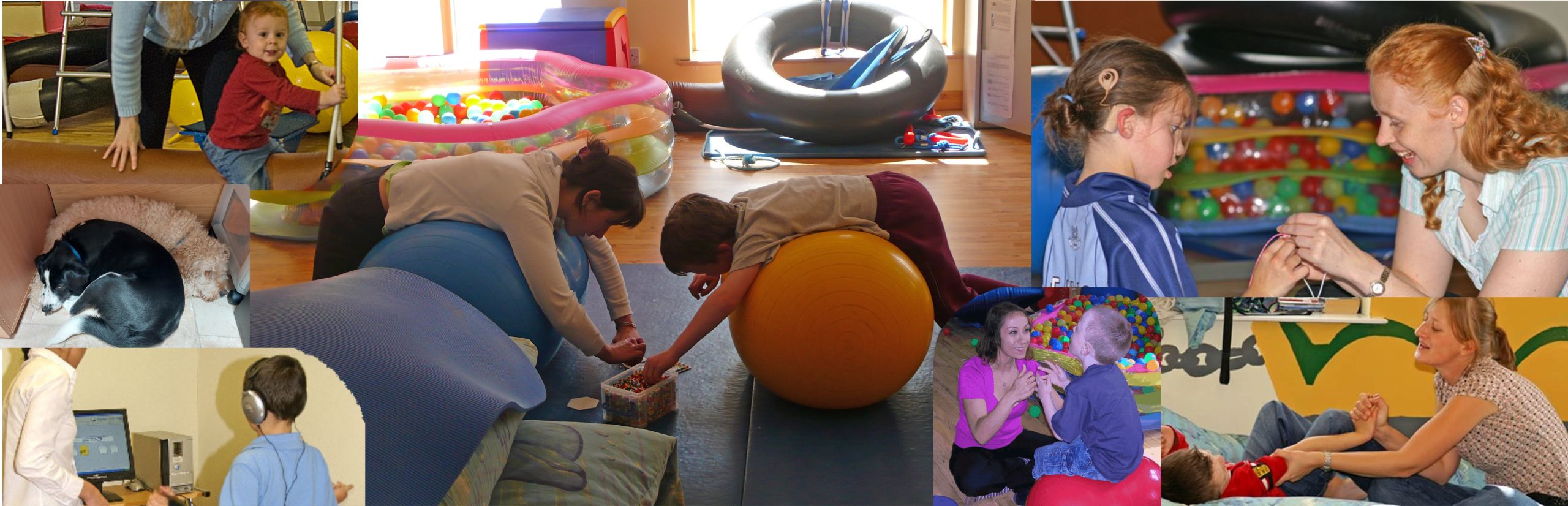
“Promoting the participation of children by enhancing their ability to participate in everyday life.”
For children/young people with motor, sensory or perceptual difficulties, the occupational therapist (OT) is a vital part of our team. The role of a paediatric occupational therapist is to assess, diagnose and provide intervention for difficulties that inhibit a child’s ability to participate in their daily activities, such as academics, social interactions, play/leisure and self-care. Therapy for the children is carried out in a friendly, lively and bright environment. Development is aided and enhanced through fun and functional activities. Experiential learning is also encouraged and facilitated.
Occupational therapists focus on the child/young person’s activities of daily living, which can be broken down into a few groups:
- Looking after themselves, (including dressing, eating, toileting, brushing teeth, bathing/showering, caring for clothes and belongings, managing pocket money etc.).
- Attending and being successful in school related tasks (This includes academics such as reading, writing and maths, as well as organising themselves, taking down notes/homework, mixing with other students, following instructions etc.).
- Mixing with peers and others, making and maintaining friendships, adapting social skills to different environments etc.
- Play & Leisure (This includes the development of play skills, range of interests, interaction with others during play etc.).
- Managing the motor related tasks of activities, such as riding a bicycle, hopping, throwing/catching a ball.
- Making sense of the sensory world and regulating their responses to everyday experiences.
The Occupational Therapist
Occupational therapy helps children/young people with many of the factors that affect their ability to participate in their everyday activities. Therapy has slightly different ways of working for each child/young person and for each challenge. When reading the following texts, please remember that this will vary somewhat depending on each person, child or family’s unique situation.
Our occupational therapists have a wide range of services and techniques available to help children develop their skills in everyday activities. Working directly with children/young people and their families, teachers and other important team members, they can maximise the child’s skills and confidence in themselves. Because of the great value of participation in all these elements, the occupational therapist focuses on ways to facilitate and enhance a child/young person’s participation in all aspects of their everyday life. By working with the family, they can explore how successful children/young people are and how they can build on their skills.
ATLAS Training uses primarily individual therapy to ensure that each session is uniquely tailored to each child/young person. Each session is planned in advance specifically for each child/young person and using family-directed goals as the guidelines for treatment. However, where appropriate, group sessions are also used to address specific aims.
At ATLAS Training, our occupational therapists are supported by a team of professionals who help enhance their service. Since many factors can affect a child/young person’s ability to participate successfully in daily tasks, the team approach is important to promoting a child/young person’s skills. Here are just 2 examples:
- For children/young people who have motor or organisational difficulties, communicating their needs or understanding others may be challenging and interfere with successful function. The Speech and Language Therapist, who uses a variety of communication strategies, can help a child/young person with expressing themselves, understanding others and participating in inter-personal or academic activities.
- For children/young people who find sensory input distressing, everyday tasks such as group activities, arts & crafts or P.E., can be overwhelming. The psychlogist uses mental health strategies to help a child/young person to resolve emotional distress, which can help build the child/young person’s confidence and ability to cope within these environments.
While occupational therapists receive a basic education at college level, our occupational therapists engage in ongoing learning and training to ensure that we have a wide range of expert skills and knowledge to draw on including:
- Sensory integration
- Interactive Metronome®
- Cognitive behavioural therapy
- Learn to Play™
- Neuro-developmental therapy
- DIR® Floortime™
- Neuro-linguistic programming
- Sensory-motor-based therapy
- Therapeutic Listening®
- Theraplay®
Find out what we are doing to promote the child/young person’s skills at home, school and at play; here is a summary of the services we offer:
Assessment
We use a variety of assessments to determine where a child/young person’s strengths and challenges lie. An occupational therapy assessment may consist of any of the following, depending on the child/young person’s age and needs:
- Sensory Processing: The way we understand the information we get from our sensory systems is an important step in choosing how to respond or function in the world.
- Motor Skills: Many times, the motor ability to do tasks may be making activities such as handwriting, playing with peers, dressing and many more challenging.
- Attention: Being able to attend/concentrate on tasks is an important part of being able to carry out and complete tasks.
- Understanding of self: Being aware of who we are and how our bodies work in space forms the foundation for many of our reactions.
- Functional Skills: Looking at the specific levels of skill in functional tasks such as dressing, playing, writing, reading and maths is an important element in supporting their success.
- Behaviour & Emotions: How we make sense of our world can influence how we react to the world and can therefore affect our behaviour and emotions.
Treatment
Treatment is the vehicle for change! A clear assessment, well-designed treatment plan and integrated team approach are the key points of a successful treatment. Our focus is on providing our families with a service that is goal-directed, i.e. driven by the priorities and goals of the parents, teachers and, if possible, of the children/young people themselves.
The aim of treatment is to give children/young people the opportunity to participate in their world in a more successful way. Being part of their community (from family to friends to schools and clubs) is an important part of a child/young person’s life, and the success of their sense of belonging often depends on their participation skills. Treatment can be an essential part of building on a child/young person’s ability to interact with their world and be a part of their community.
Linking
No child or skill occurs in isolation. At ATLAS Training we assure that we are supporting the whole child by linking in with families, teachers and other professionals. As an integrated team we also link very closely with each member of our team to ensure that the whole child is supported as well as their families and teachers.
Academics
As academics and school participation forms such a large part of a child/young person’s life we have specific programmes, from handwriting to attention, designed to help children/young people be more successful at school. These specific specialised programs are perfect for building academic skills.
Support and consultation
Consultation services are ideal for supporting parent issues at home or teacher concerns at school. From managing a child/young person’s behaviour to developing a child/young person’s skills, consultation sessions with an occupational therapist can help parents and teachers develop the tools to support children/young people. An initial consultation with a member of our team costs just €65.
ATLAS Training offers a wide variety of workshops, training courses and support groups for parents, teachers, special needs assistants and others.
Supervision
In addition to the above services, Catherine Milford, who is an experienced occupational therapist and psychologist, offers supervision for occupational therapists working in paediatric posts.
Participation
The process of doing tasks within and together with people in our community is an essential part of who we are.
“Doing, Being, Becoming and Belonging” — Anne Wilcock, 1999
Participating consists of 4 essential components:
- Doing: doing is an essential part of being human. It is usually to meet some need or to produce some form of end-product, whether it’s writing a sentence for your teacher or riding a bicycle with friends.
- Being: This is about who we are and doing tasks is a reflection of this. This involves the important roles in our lives, such as being a student, being a friend, being a son/daughter. Participating in tasks gives us a chance to be who we are and express that through the tasks we do.
- Becoming: Participating in tasks is also important for developing the person we are going to be. For children, this is even more important as their choices, successes and experiences in everyday tasks shape the person they are going to become.
- Belonging: To join in with others in tasks, or to share the same values fosters a sense of belonging to a group. Whether this is eating dinner with the family or playing football on the green, it is through participation that we establish our place in our communities.
“Holding the minds and hearts of children in our hands”
Children/young people take many years to develop the emotional resilience and life skills to become the adults they are destined to be.
Some children/young people are faced with challenges that make this process more difficult. These childen/young people may be struggling to cope with everyday life now, or be at risk of having future difficulties with coping skills.
The role of the psychologists at ATLAS Training is to support them in learning to cope with the challenges life throws at them. We do this by supporting them in many different areas:
- Emotional and coping skills.
- Executive and organizational Skills.
- Self-awareness and self-esteem.
- Learning and related Skills.
- Social skills.
- Literacy development.
Assessment
We use a variety of assessments to determine where a child/young people’s strengths and challenges lie. An occupational therapy assessment may consist of any of the following, depending on the child/young person’s age and needs:
- Attention: Being able to attend/concentrate on tasks is an important part of being able to carry out and complete tasks.
- Coping Skills: Handling the occasional (and sometimes more frequent) knocks that life throws our way is essential for our mental heath.
- Executive Functioning: Our ability to make adaptive decisions and problem solve through everyday tasks depends on our understanding of the world and our ability to flexibly use our cognitive resources.
- Memory and Learning: Our ability to take in and retain information from our world has a direct impact on academic success.
- Social Skills: Interacting with people around us and making and keeping friends keeps us connected to our social world.
Treatment
Treatment is the vehicle for change! A clear assessment, well-designed treatment plan and integrated team approach are the key points of a successful treatment. Our focus is on providing our families with a service that is goal-directed, i.e. driven by the priorities and goals of the parents, teachers and, if possible, of the children/young people themselves.
The aim of treatment is to give children/young people the opportunity to participate in their world in a more successful way. Being part of their community (from family to friends to schools and clubs) is an important part of a child/young person’s life, and the success of their sense of belonging often depends on their participation skills. Treatment can be an essential part of building on a child/young person’s ability to interact with their world and be a part of their community.
Linking
No child/young person or skill occurs in isolation. At ATLAS Training we assure that we are supporting the whole child/young person by linking in with families, teachers and other professionals. As an integrated team we also link very closely with each member of our team to ensure that the whole child/young person is supported as well as their families and teachers.
Academics
Unfortunately, the key to a child/young person’s success in life is in large part due to their success at school. For many children/young people school can pose a variety of challenges from the basics of reading, writing and arithmetic to more profound challenges, such as concentration, organisation, listening skills, study skills and many more. At ATLAS Training we help children/young people cope at school in many ways, including recommending accommodations, adaptations or resource teaching in school, supporting teachers and parents and School Success Programmes. These specific programmes are designed to target specific skills, from handwriting to attention and many more.
Support and consultation
Consultation services are ideal for supporting parent issues at home or teacher concerns at school. From managing a child/young person’s behaviour to developing a child’s skills, consultation sessions with an occupational therapist can help parents and teachers develop the tools to support children/young people. An initial consultation with a member of our team costs just €65.
“The limits of my language mean the limits of my world.” — Ludwig Wittgenstein
One of the most important skills a child needs is to be able to interact and communicate with the people around them, whether to ask for something, follow directions or to play successfully with other children/young people. For some children/young people, these skills need a little help in developing and that’s just what we are here for.
For children with communication difficulties, the speech and language therapist (SLT) is an integral part of our team. The role of a paediatric speech and language therapist is to assess, diagnose and provide intervention for speech, language and communication-related difficulties in children/young people of all ages. The paediatric SLT also deals with oral-motor, eating and swallowing difficulties in children/young people.
Therapy for the children/young people is carried out in a friendly, lively and bright environment. Speech, language and communication is aided and enhanced through fun and functional activities. Experiential learning is also encouraged and facilitated.
ATLAS Training has experience working with children/young people who have any of the following:
- Difficulty understanding language.
- Difficulty with feeding and swallowing due to structural/or abnormalities.
- Difficulty with the intelligibility of speech production (articulation, phonology and DCD/dyspraxia).
- Difficulty with fluent speech (stammering/stuttering).
- Difficulty using verbal and/or non verbal language to express needs and wants.
- Difficulty with the social aspects of communication.
Assessment
We use a variety of assessments to determine where a child/young person’s strengths and weaknesses lie. A speech-language therapy assessment may consist of any of the following, depending on the child/young person’s age and needs:
- Oral Motor Examination: This assesses oral structure, movement, function and muscle strength. It also assesses the presence of hypersensitivity/hyposensitivity of the mouth.
- Feeding/Swallowing Assessment: This typically includes an assessment of current feeding and swallowing patterns, from the amount of saliva production, to the swallowing reflex and time for the swallow to take place. Food consistency and texture of food are also discussed. Chewing during the oral phase of feeding will be assessed.
- Speech Assessment: Speech is assessed in terms of the sounds they are able to produce and how well they integrate these sounds into their speech.
- Language Assessment: Receptive (understanding) and expressive (spoken) language is assessed using various formal and informal assessment tools. Such an assessment can also look at the use of language in social situations such as with peers/groups etc.
- Auditory Processing Assessment: The ability to make sense of the sounds they hear is explored.
- Literacy: Phonological awareness skills and/or reading and writing abilities are assessed.
Treatment
Treatment is the vehicle for change. While the assessment helps us find out if speech or language is delayed, it doesn’t give us the tools we need to build on these skills. Perhaps the most important next step is treatment.
The aim of treatment is to give children/young people the opportunity to participate in their world in a more successful way. Being part of their community (from family to friends to schools and clubs) is an important part of a child/young person’s life, and the success of their sense of belonging often depends on their communication skills. Treatment can be an essential part of building on a child/young person’s ability to interact with their world and be a part of their community. Treatment takes place in a fun and engaging environment supported by a whole team.
Linking
No child/young person or skill occurs in isolation. At ATLAS Training we assure that we are supporting the whole child/young person by linking in with families, teachers and other professionals. As an integrated team we also link very closely with each member of our team to ensure that the whole child/young person is supported as well as their families and teachers.
Academics
Literacy is a developmental skill that entails the individual’s ability to read and write. We start applying reading skills (orthographic reading) from a very young age. Initially, such reading takes the form of shape/pattern recognition, e.g., reading ‘STOP’ from a sign, recognizing DVD names and titles, reading car names from the logo, etc. Later, letter-sound recognition and blending sounds leads to more constructive, complex reading.
Support and Consultation
Parents, teachers and other care-givers play a valuable role in promoting a child/young person’s communication skills. By offering education and consultation to these key people, the greatest improvements will be seen in the child/young person. An initial consultation with a member of our team costs just €65.
ATLAS Training offers a wide variety of workshops, training courses and support groups for parents, teachers, special needs assistants and others.
Children/young people who have a history of a speech and language delay or difficulties are often at risk of having reading and writing difficulties later on as well. The reason for this is that literacy and verbal communication are closely linked.
Therefore, early intervention and/or continuing speech-language therapy are the best options for children/younh people with a history of speech and language problems.
At ATLAS Training, the SLT works on all aspects of a reading and writing problem because people use literacy for a variety of functional purposes: from writing single words to writing a school essay; from reading a sign to reading a recipe, an ordinary book or a work memo. The SLT also works with the OT and teacher if necessary to help the child become an effective communicator, problem-solver, and decision-maker.
Here are some of the skills targeted during literacy therapy:
- Working on and reinforcing phonological awareness skills.
- Reading and writing fluently and efficiently.
- First stages in reading and writing, simple to complex words.
- Planning and sequencing what to write and what to write about, and spelling.
- Reading for content and comprehension.
- Reading and writing for pure pleasure.
As a parent you can help and support a child/young person on the path to literacy:
- Provide plenty of opportunities for reading to them and story telling.
- Have a variety of books with varied content available.
- Choose books with simple pictures which can be labeled and described in simple language.
- Talk about writing and its functions i.e., when writing a shopping list.
- Let the child/young person see you reading and enjoying books.